Fifty years of paper, gone in four weeks.
A manufacturer in Geelong. Around thirty people on the floor and a handful in the office. They build good gear and they had been running the paperwork the same way for about fifty years. I replaced the paper with a quoting system, job tracking and a live dashboard, for a fixed price, in four weeks.
Everything went through one bloke.
Quotes were done by hand. Parts and labour worked out on a pad, priced off memory and experience, then typed up and sent. On a busy week that was about five hours a day gone, and it was always the same person doing it, because he was the only one who knew how the numbers went together.
Jobs went up on the workshop wall in marker. That is not as daft as it sounds. It is the fastest way anyone had found to tell thirty people what was on today. The trouble is a wall does not remember anything. Once a job was wiped off, the only record of what it took was a stack of paper time cards and whatever the owner could recall.
The time cards went to the office, where someone retyped them into a spreadsheet. So the office was always about a day behind the floor, and by the time you found out a job had blown its hours, the job was finished and the money was gone.
They were not after a transformation. They wanted the paper gone and the owner off the critical path.
One system, four parts.
Quoting system
Parts, labour and margin in one place, with the numbers the business already uses. A quote that used to take the best part of a day now takes minutes, and it looks the same every time no matter who sends it.
Job tracking
Every job has a record instead of a line on the wall. What stage it is at, who is on it, hours logged against it, and how that compares with what was quoted.
Live workshop dashboard
A screen on the wall showing what is on today, who is clocked on and what is running late. The wall still tells you what is happening. It is just current now, and nobody has to rub anything out.
Office tablets
Tap your name, tap a PIN, pick the job, log your hours, walk off. About fifteen seconds with work gloves on. No accounts to remember and no app to install.
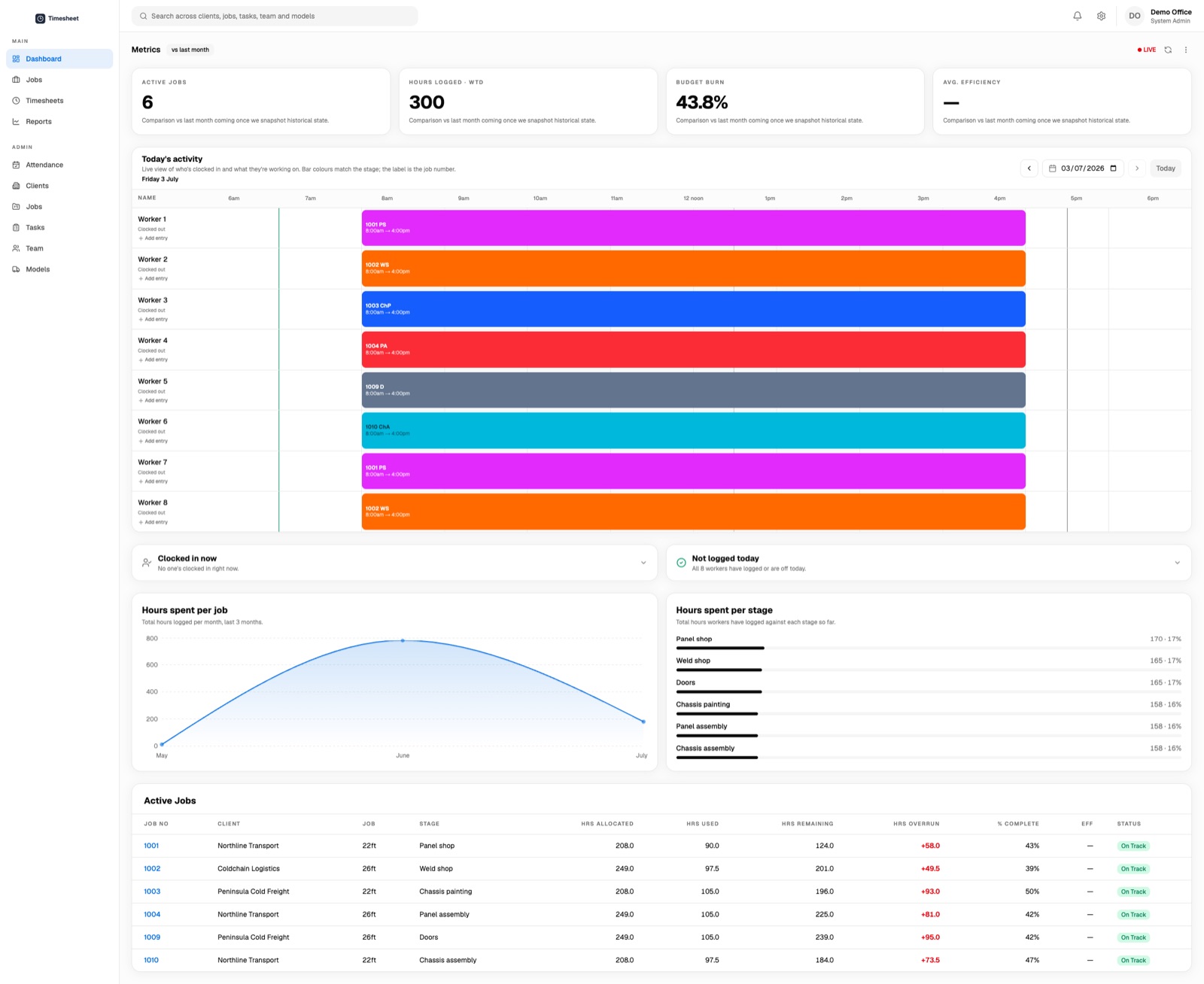
What actually changed.
Quoting went from about five hours a day to minutes. That is the one the owner cares about, because those five hours were his and he was not getting them back any other way. It also means a quote can go out the same day it is asked for, which wins work on its own.
Fifty years of paper time cards are gone. Hours get logged on a tablet by the person who did the work, once, and they are in the office the moment they are entered. No retyping and no day of delay.
The whole office runs on it. Not a pilot on one team and not a screen nobody opens. It is where the work lives now, which is the only test of this sort of build that actually matters.
Fixed price, tight scope, four weeks.
I priced the whole thing up front and put it in writing. No hourly rate, no monthly invoice that keeps arriving, no change order for every small thing. Four weeks is not long, but it is enough if you are strict about what goes in and honest about what does not.
Most of the real work went into the parts that do not demo well. Buttons big enough for gloves. A flow that forgives you when you tap the wrong thing. Keeping it working when the Wi-Fi drops, because in a shed it will. Taking the lunch break out automatically so nobody has to remember. A floor that has run on paper for five decades does not owe your software any trust. You earn that by being reliably boring.
The four weeks got us to a working system, which is the start rather than the finish. The most useful stretch came after go-live, once real people were using it in the real building and telling me what was annoying.
Got a version of this in your business?
Most places have one. A quote that takes half a day, a job list on a whiteboard, a spreadsheet only one person understands. If you want to know what it would take to fix, call me or book a Build Blueprint and I will spend a day on site working it out properly.
Book a scoping callBook a BlueprintStackCraft, Chris Jack. Custom software for businesses across Geelong, the Surf Coast and Melbourne. www.stackcraft.com.au